As part of a long unit on World War 2, we're currently completing a short unit on World War 1--we'll study it in depth another time, but right now I'm primarily interested in having the children understand how World War 1 affected World War 2, so I'm emphasizing the timeline of events (using Story of the World, maps, and plenty of ready-reference), the conduct of the war (focusing on trench warfare), and the consequences of the war (also primarily using Story of the World and maps, but we're also going to watch a documentary on Jesse Owens this weekend).
To that end, after reading about trench warfare in Eyewitness World War 1 and watching this opening scene from All Quiet on the Western Front (I'd not recommend a Google Image search on this subject, as the results would be too upsetting for elementary children)--
I set up a LARP trench warfare activity for the kids. Here's what we used:
inverted spray paint. It paints on the ground, and we use this a TON for various yard games and projects.
measuring tape
two small shovels. I'd been kind of wanting child-sized, REAL shovels for a while, the better to put the children to work for me, so this was my excuse to buy them.
water guns
water balloons
bandanas.
bicycle helmets (optional). I'd wanted to add various items of clothing to imitate soldiers' uniforms, such as bicycle helmets and vests, but the day was too hot for that. Although heat exhaustion *would* be authentic...
First, the little kid and I measured out a battlefield. We needed space for two trenches, far enough apart to make hitting the other side with water balloons and water guns challenging but not impossible, with a No Man's Land in between. The little kid decided on a distance of about 13 feet, and it worked great.
The kids filled up a supply of water balloons, filled up a bucket to serve as a reservoir for water gun refilling, and dragged it all out to our war zone.
I wasn't sure how much effort the kids would want to put into digging their trenches, so I simply left them to it, asking them to tell me when they were both finished. This is what it looked like while they were working, before I sneaked off to have a snack and read for a bit:
This day was the only day this week that it didn't rain (and it's raining again today, sigh...), so the ground was quite soft, which helped the kids create some truly epic trenches for themselves:
Notice the piling up of the dirt to make a barrier in front of the trench? Good form!
When the kids were finished, they each ended up with a trench and barrier deep enough to crouch behind. Pretty perfect, I think:
When the kids had filled all the water balloons, they were left with an odd number, so it was decided that I would begin the war by playing the part of terrorist Gavrilo Princip and tossing a symbolic water balloon into the air; this was done, and war had begun!
Prior to the beginning of the war, there had been much debate about who wanted to be which country; the big kid wanted Germany, but the little wanted Austria. Then she wanted Russia. When you're playing war, why does everybody ALWAYS want to be the bad guys?
Finally, the little kid was persuaded to play France, so safely ensconced in their trenches, France and Germany commenced their bombardment:
See the water balloon?
Germany goes over the top!
Retreat!
France and Germany both wore bandanas around their necks. Every now and then, I would shout "Gas! Gas! Gas!" and the soldiers would have to put on their gas masks:
When someone needed to refill her water gun or rebuild her trench, she could shout, "Armistice!", and temporarily pause the war:
And then, back to war!
Of course, things got out of hand. First, France chased down Germany, knocked her down, and threw a bomb in her face. In retaliation, Germany kicked in France's trench and stole the rest of her bombs. France looked like this--
--and Germany looked like this:
Fortunately, France recovered (after I reminded her that FRANCE wins, not Germany), and all was again well:
This activity turned out WAY better than I'd hoped it would. The kids were really into it, they remembered enough from our World War 1 studies to naturally add some authenticity to their role-play, they got some great exercise and had a fabulous time, and I seriously doubt that they will ever forget the major contenders or major form of warfare of World War 1.
The kids asked to leave the trenches in place, which is fine, but I required them to pick up all water balloon shrapnel at the end of the game. Eventually, I'll have them fill their trenches back in, although if they wanted to use that space to make a couple of permanent forts...
...well, I wouldn't protest.
P.S. Want to follow along with my craft projects, books I'm reading, road trips to weird old cemeteries, looming mid-life crisis, and other various adventures on the daily? Find me on my Craft Knife Facebook page!
You can probably tell that I used our own candle holders, with our own monograms, as the examples in the photo, but the rest are to be drilled to order in either birthday candle, Waldorf ring candle, or taper candle sizes:
I like the look of the vintage blocks, and as candles come and go, they develop lovely layers of dripped wax to show evidence of their use:
If these work out, I've got more ideas for more types of candle holders--Waldorf rings, tree branch holders, pallet wood holders, and so on.
Now I just need to figure out candle holders that are either dinosaur- or chicken-shaped, and I'll be all set!
After over a year and a half of constant complaining about it, I finally dropped First Language Lessons. It wasn't working for us, and by that I do not mean that it wasn't fun, because I don't personally feel that every school subject has to be the educational equivalent of a trip to the water park. No, I could handle First Language Lessons being dry and tedious.
What I couldn't handle was the eventual, slow realization that my kids weren't learning anything from it. That question and answer, rote-style, fill in the sentence diagram just wasn't getting anything into their brains. The kids weren't really able to identify or construct anything outside of FLL's scaffolding. They couldn't diagram a simple sentence of my own creation. They could barely tell the subject from the predicate! We dumped it, therefore, and I'm back to winging my own grammar curriculum. My goals are to teach grammar concepts as they come up, to continue to emphasize memorization (which FLL *was* great for, but the kids just didn't understand what they were memorizing), and to focus on identification and construction.
I want the kids to be able to identify all grammar concepts, of course, but that will eventually become pedantic. The true purpose of grammar education is gaining the ability to USE these grammar concepts, so that's what our goal should be, no matter where we are in the process.
Currently, I'm teaching compound, complex, and compound-complex sentences, beginning, of course, with compound sentences. You can learn this concept as soon as you've learned nouns, verbs, subjects, predicates, and the definition of a complete sentence, and it's actually a great place to go next, because you'll get a lot of practice in identifying and creating complete sentences, and you'll learn your conjunctions.
There's a good definition of the compound sentence here, and you'll also want to have the kids memorize the short list of coordinating conjunctions. The main point to make, however (and this is an important one, because it's both crucial to differentiating a compound sentence from a complex sentence, AND almost every other elementary resource that you'll find does not teach the correct way to identify a complex sentence, so you'll be relying on this difference when you teach it yourself the correct way), is that the two independent clauses do not rely on each other. They both have equal weight, equal importance in the sentence.
The kids won't understand that when you say it. They'll need examples--LOTS of examples. That's when you play Compound Sentences against Humanity!
Cards against Humanity is similar to Apples to Apples, but more user-generated, MUCH more irreverent, and much, MUCH more fun! I'm working on a Junior version, myself, but Cards against Humanity is otherwise very much for adults.
Compound Sentences against Humanity, however, is for everyone! This game is completely user-generated, since we're making it up, so you can include independent clauses about family members and inside jokes. Try to make all the independent clauses irreverent, as well, because that's way more fun for the kids than sentences that read, "The children pet the cat," etc. Blech!
To play this game, you'll make a set of independent clause cards and a set of coordinating conjunction cards. Make them using the Cards against Humanity template here. I did not include any "nor" cards, because the independent clause structure would have to be altered, and I also took out the "for" cards after the first game, because it was too hard for the kids to correctly structure an independent clause using it. They still memorized those coordinating conjunctions, but we'll deal with their structure another time.
Here are some of my independent clauses:
Barack Obama is my favorite superhero.
The Boy Scouts ate at Five Guys. (This is an inside family joke, stemming from an imaginary Boy Scout/Girl Scout rivalry that we pretend exists whenever we see Boy Scouts in uniform.)
I had some longer independent clauses that I removed after the first game, since the game requires copying them down onto your dry erase board, and it was taking forever.
This game works best with three or more players, because you'll go around the circle and have one player act as judge each time. Everyone else is a player, and everyone should have their own dry erase board and dry erase marker, with a cloth nearby to erase the boards between rounds.
The judge draws one independent clause card and one coordinating conjunction card (I marked the back of the coordinating conjunction cards with a C. Later, when we add subordinating conjunction cards, I'll mark those with an S):
Ignore the fraction on the back of that card; I'm reusing old cardstock.
The players will then copy that independent clause onto their dry erase board, add the comma and coordinating conjunction that are required to make a compound sentence, and then create their own independent clause to follow:
When the players are all finished, they turn their boards around and take turns reading their compound sentence:
All sentences will be admired, and the judge will award a unique prize to each sentence--Most Improbable Act to Occur Underwater, for example, or Stuffed Dinosaur the Size of Your Bedroom, etc. All prizes are, of course, imaginary. Rotate to a new judge, and play begins again:
This clause was too long, so I've since removed it from the game.
You really only need to play this game long enough for everyone to have a turn to be the judge. You don't want the kids to get tired of copying and writing, and even in three rounds, that's still two unique examples that they've created and four unique examples that they've read. But you'll want to play it again often, until you can see that it's a total no-brainer for the kids to correctly construct their compound sentences.
As extra practice, you can also have the kids work independently to write compound sentences using these cards, and then to mark nouns, verbs, subjects, predicates, and conjunctions on their sentences. They can copy just the independent clause cards and mark nouns, verbs, adjectives, adverbs, subjects, and predicates. They can diagram just the independent clause cards. They can be in charge of creating a new set of independent clause cards.
Once that's a no-brainer, AND they've memorized a textbook definition of the compound sentence AND the short list of coordinating conjunctions, you can move on to complex sentences or to diagramming compound sentences.
P.S. Want to follow along with my craft projects, books I'm reading, dog-walking mishaps, encounters with Chainsaw Helicopters, and other various adventures on the daily? Find me on my Craft Knife Facebook page!
Yesterday was a 4th of July celebrated Girl Scout-style! You know how much we love our town's Independence Day parade, so I was pretty excited to sign my troop up to walk in it this year.
And it WAS exciting, although of course a totally different ballgame from simply showing up with a lawn chair and sitting my butt down to spectate. First of all, I didn't sit my butt down for the entire morning. Well... I kinda did, but also not. I was on the ground, but rather than chilling out, I was doing this:
This wasn't one of my best creations. You should have seen my flag!
I'd spent the evening before Googling "patriotic face painting," and while I was NOT going to be able to paint Girl Scout faces to look like screaming eagles or fireworks skyscapes, I was pretty confident that I could do a silver star, with red and blue streamers around it. So that's what I offered, as each Girl Scout came to sit in front of me: "Would you like a star on your cheek?" I asked. The Girl Scout would nod, I'd paint her a silver star with red and blue streamers around it, I'd show her what it looked like in the mirror, she'd smile and thank me, and the next kid would sit and get her star.
Until one kid asked, "Can I have a flag instead?"
"Why not?" I decided, and attempted a flag. Blue square, red stripes, silver stripes (we're almost out of white), couple of silver dots on the blue. Flag! Add it to my specialties.
So then when a kid sat down in front of me, I asked her, "Would you like a star or a flag?" The kid would tell me which, I'd paint it, and off she'd go.
Until one kid asked, "Can I have a star AND a flag?"
"Why not?" I decided, and painted her a star on one cheek and a flag on the other. No problem.
And then kids started sitting down in front of me with a star or flag already painted on one cheek, happily ready for me to paint their other cheek. No problem.
Until one kid (MY kid!), asked, "Can I have a firework?"
Hmmmmm..... At first I thought about painting a firecracker with sparkles coming off the wick, but then instead attempted a sort of asterisk in red and blue and silver. That didn't turn out super well, but I knew what was going to happen by now, so when the next kid sat down and asked for HER firework, I refined it to a sort of asterisk in red and blue, with silver in the middle and silver sparks around it. It looked... okay. Not completely unlike a firework, I do declare.
And then, as I'm sure you've already guessed, kids started sitting down in front of me with a star and a flag already painted on their cheeks, asking for fireworks on their foreheads. No problem, except that I'm pretty sure they all kicked up a fuss about wearing their hats afterwards. Mustn't smear the fireworks, you know.
If we walk in the parade next year, I'm totally going to study up and practice. Look out for the kids with full-on screaming eagle and firework skyscape face paint!
Meanwhile, the kids who weren't getting their face painted were busy putting Girl Scout stickers on suckers--
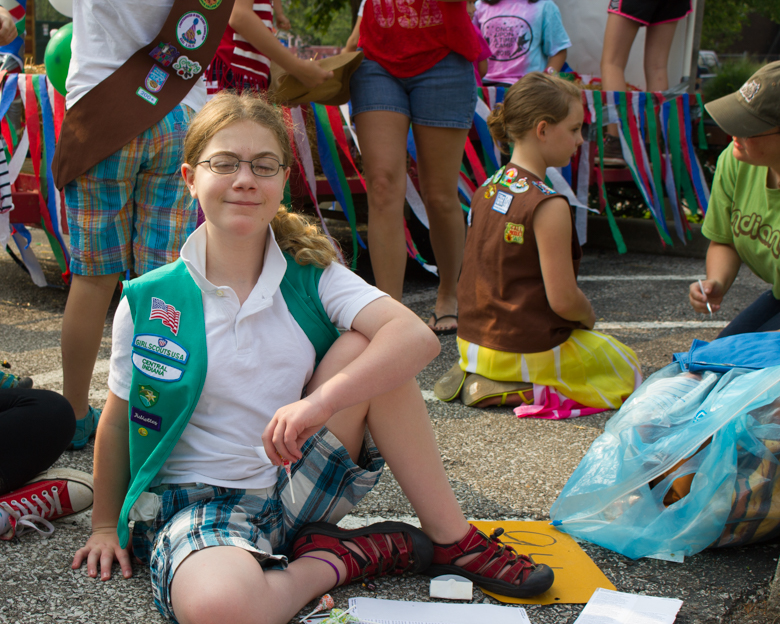
--and cooling their heels, attempting to not get into trouble:
See me in the background? I'm painting stars and flags!
I'd also brought sidewalk chalk, and only once did a child write the word "poop" in giant letters on the sidewalk, and she happily covered it in chalked sparkles when I asked her to.
At one point, some of my troop wandered away a bit, and another troop chaperone walked over, clearly intending to ask them who on earth was supervising them. I saw this and totally sent Matt over, explaining to my friend and fellow chaperone, "They won't chastise him--he's a dad! They'll probably congratulate him for interacting with his children."
Totally stereotypical, I know, but you'd be surprised (or not, depending on how tuned in you are to sexism in parenting) how often that works!
In all the prep work for the parade, I'd kind of forgotten about, you know, the PARADE. And so when we finally were herded to our place in the line and finally began the walk, and we turned the corner onto the parade route, I audibly gasped (to be fair, so did my fellow chaperone!) at the giant crowd of people on both sides of us, all cheering and waving and LOOKING. AT. US.
Thankfully, I had only a mild panic attack before I realized that they were, of course, actually looking at the adorable children in their Girl Scout uniforms, and at the candy that the adorable children were handing out. It was better-ish after that, although an hour after the parade was over, I looked at myself in the bathroom mirror and couldn't decide if my pink cheeks were sunburn, or if I was still blushing from the ordeal.
Little of both, I eventually decided.
The kids all had a fine time, of course, which was the point of the operation. Nobody got run over by the trailer, which was my particular worry, and I only had to save two of them from that exact thing--a chaperone win! Will, I think, had a better time than Syd--all those people!--but all my Scouts seemed happy, enjoyed the walk, didn't skin their knees or get snatched by a stranger in the crowd, waved and were cheered for, handed out candy, and can now say that they have marched in a parade!
Since our whole troop was going to be together on this day for the parade, we'd decided to convene afterwards at one family's house to have a potluck and celebrate the Bridging of three of our troop members and the Investiture of them all.
Bridging is the ceremony in which a Girl Scout officially advances from one level to the next. There are special activities that she's asked to do to help her synthesize what she's experienced and prepare her for the heightened responsibilities of her new level. There's also a lovely little ceremony involved, that involves crossing--yes, an actual bridge. Our ceremony consisted of having the kid cross to the center of the bridge while a parent spoke about the kid's accomplishments during her time at that level, then she completed the crossing, removed her old uniform vest or sash, and her troop leader (that's me!), helped her put on her new uniform vest. It was a beautiful way to honor all that each kid had done:
People were looking at her, poor kid, so she was nervously bopping that balloon.
And, of course, there's cake! Bridging has a rainbow theme, so I was able to once again trot out my favorite rainbow cake recipe--
--and the kids made a rainbow fruit and vegetable platter to share:
After the potluck, you will not be surprised to know that we went home and took a nap. Well, Matt and I took a nap--I'm pretty sure that the kids just played LEGO Jurassic World on Xbox. I checked it out for them from the library, which means that I'm having a hard time enforcing any screen time limits on it. It IS really fun, AND we only have it for three weeks...
So of course what did the kids want to do that night?
Watch Jurassic World at the drive-in for the THIRD time.
Of course.
Just enough time for a few at-home fireworks beforehand:
This might possibly be the best 4th of July that we have spent as a family. It had all the elements that we love best--parades, friends, parties, cake, fireworks, family...
Often I'll have Will sew the fun patches onto her Girl Scout vest and Syd's vest, but I tend to place the insignia and earned awards on myself, and...
I sew them. Despite the fact that the badges are all iron-on, I sew them.
I don't know if it's something about my technique, or something about my iron, or something about me as a person, but iron-on patches just do not iron on for me!
Sure, they may act as if they've ironed on, and they may indeed stay ironed on for a few weeks, but after some wear, and DEFINITELY after a wash, they gradually but certainly start to come undone. I hate that. Total pet peeve.
And honestly, if you really count the amount of time that it takes me, at least, to press and wait, and press and hold, and press and check, and press some more, and then come back later and fix them when they start to come unstuck later, it just takes less time to simply sew the damn things on in the first place.
To sew on Girl Scout badges instead of ironing them, all you really need are:
sewing machine with a sharp needle: It doesn't need to be heavy, just sharp.
thread matching the Girl Scout vest for the bobbin
1. Figure out where everything goes. This is 90% of the effort involved in sewing on the Girl Scout badges. I messed up a couple of times on Syd's vest, sewing fun patches that I mistook for the official badges onto the front of her vest (the Girl Scout shop stocks a Pottery fun patch as well as a Pottery official badge, which if you're a noob, is hella confusing, Girl Scout Shop!), but even if you do that, really it's no big deal, unless your kid is going to meet the president while in her uniform or something, which I know could totally happen! But you'll have advanced knowledge, in that case, so you'll have time to spiff it up.
Otherwise? NBD.
2. Glue it on. Don't glue everything on at the same time, but instead badge by badge, except in the case of the council insignia and the troop numbers, which need to be glued on together because you'll be sewing them all at once.
Just put a generous amount of glue from the glue stick onto the back of each patch, then press it firmly onto the vest until it's nice and stuck:
Don't get your hopes up, because this won't stick forever, or even for a super long time, but it will stick well for about the next half-hour or so, which is plenty long enough for you to get it sewn on.
3. Sew it on. Using invisible thread on the top, and thread that matches the vest color in the bobbin, edgestitch around the patch. Fun patches, with their horrible unpredictable shapes, don't need to be painstakingly edgestitched--just go at angles more or less all around, and if a couple of sticky-outy bits aren't stitched down, it won't be noticeable.
There's a slightly different method for council insignia and troop numbers:
For this 3479 for instance, I sewed all the way across the top--9743--then down the 3 to the bottom and across. When I reached the bottom edge of 3, I sewed up that edge, across the top to 4, down 4 and across, up 4 and across to 7, etc.
If you're having trouble with your thread tension while sewing on these patches--the invisible thread breaking, say, or loops forming at the back of the vest--then your needle probably isn't sharp enough. When in doubt, I ALWAYS replace my needle. It's crazy how often that fixes my problem.
Now, all that being said, if you don't want to sew or you're getting frustrated (I had sooooo much to sew onto Girl Scout vests the other night, and after a full episode of Gilmore Girls, I was over it and ready to move on with my life), then use Aleene's Fabric Fusion instead. I like it better than any other fabric glue, including Aleene's Okay to Wash It.
In conclusion, thank you for sitting through that really long, type-A tutorial! I am 100% positive that there is nobody else on this planet who cares that much about how to correctly sew on Girl Scout patches, but that's okay. There's room enough for all us odd fellows.
Some of you may know that fandom, and fan cultures, are major interests of mine. I'm interested in fan cultures academically, because I'm fascinated by the immersive experiences that fans can create around a book, movie, TV show, or video game, and the community that also participates in this experience, and extends it. People take ownership of creative works that already have "owners," because creativity cannot be owned. They feel empowered to rewrite and recast characters and situations to fit their own visions, whether it's finding a way to get Harry and Hermione together as a couple, or exploring the adventures of Rose Tyler and John Smith in their alternate universe. People also forge communities through their fandom, subverting the often socially isolating experiences of TV watching, book reading, and video game playing. They connect online, of course, constantly, finding common ground with other people all over the world who also think there's totally a ton of sexual tension between Sherlock and John, but they also connect in person, through conventions, and the experience is really, really, really fun.
I say that last part because, of course, although I'm very interested in fan culture academically, I'm also interested in it personally. I read and write fanfiction. I have a favorite wizard rock band (It's Swish and Flick, for those of you playing the home game). I collect fan art. I make fan art. I attend fan conventions. And, yes, I cosplay at those conventions. Here I am cosplaying as my favorite superhero, Krrish, at the Indy Pop Con last weekend:
Matt went in regular clothes, but with Sharpie tally marks up and down his arms as one who fights the Silence, and the children cosplayed as their OCs, The Awesomes.
There are a ton of things to do at a fan convention. Some people like to meet celebrities and get photos and autographs. Some people like to buy rare collectibles. Some people like to photograph the other cosplayers. Some people like to meet up with their friends who they usually only interact with online. The kids like to shop for vintage toys and, for Will, dragons and sharp pointy things. Syd likes anything My Little Pony. Matt likes to watch live gaming (at this con, we sat in on a Halo championship that was being livestreamed on Twitch--very cool). I like to browse the fan art for sale in the exhibit hall, all of which is created by super-talented indie crafters and artists, check out brand-new indie comic books and video games, and attend the workshops and panels.
I really like celebrity panels, because I'm always interested in the process of creation, and I always like to hear about a writer or actor's experiences. At this con, for instance, I insisted that we all get up bright and early so that we could be sitting in our seats in the third row of the main hall in time for the first panel of the day, a Q&A with Sam Jones, star of Flash Gordon:
Although Jones is now back in filmmaking, he has apparently spent much of his time since Flash Gordon running a security and extraction services business aimed at high-profile businesspeople traveling to Mexico.
Jones spoke a lot about his experiences making Flash Gordon, of course, but also about his cameos on Ted and Ted 2, and since these are his only film credits, and there's so much time separating them, I was curious about his thoughts on the evolution of filmmaking during that time. I mean, just animating that talking teddy bear in Ted uses technology way beyond all the tech involved in making all the effects in the special effects-heavy, sci-fi Flash Gordon.
As I'm standing with the microphone, however, asking this question, I go off on a little tangent (of course) about how much I'd loved Flash Gordon as a kid, and how one scene in particular--the one in which they're sticking their arms into the woodbeast's lair, when at any moment it could bite their hand off--had scared the stuffing out of me, even though it had required no special effects at all, and I said that I'd watched Flash Gordon "a lot."
"How many times?" Jones asked me.
Well, when Flash Gordon is asking you how many times you've seen his movie, you've got to tell the truth, so I replied with the approximate number, and this number was so large that even the other fanboys/fangirls in the audience with me audibly gasped.
And in case you're curious, the acting in that woodbeast scene was so good, Jones says, because it was an open set, and the lair was actually elaborately constructed as an actual lair, and the actors were actually concerned that little animals could actually have sneaked inside it at some point and could actually be waiting to bite them when they stuck their arms in.
John de Lancie, at his Q&A, had a lot more ground to cover, because he has been in TONS of stuff:
It was interesting, however, to see the way that he thinks of his career. Whereas Edward James Olmos, who I'll tell you about in a minute, had some very powerful things to say about why he chooses only projects that are personally meaningful to him, and how he treats his acting as art, de Lancie portrayed himself as much more of a career actor who chooses his roles based on time and money. For instance, he says that by the time My Little Pony became a hit and people began to contact him about his role as Dischord in the series, he had completely forgotten about having done it. He'd accepted the part, prepared for the role, voiced all his scenes over three days in the audio booth, and then gone about his business, leaving it all behind him.
He therefore had more interesting things to say about the technical aspect of acting, how to fabricate a side story to save a poorly-written scene, how to work with other actors, how to prepare your voice for the recording studio (never eat chocolate when you're going to be doing voice work!).
So he was interesting. And Sam Jones was interesting. But Edward James Olmos?
He was freaking AWESOME!
I'm mostly familiar with his work in Battlestar Galactica and Dexter (I know he's also on Marvel's Agents of SHIELD, but I'm not up to date with that series yet, so don't spoil me!), so I already knew that he was a great actor, but the stories that he told about his work, and the way that he cogently explained how he decided to take the projects that he did, were incredible. He was really sharing what it was like to be a gifted artist and how to make meaningful contributions to society using his gift.
For instance, his role on Miami Vice? He was offered that part while he was still a relatively new actor, and one would think that he would still be interested in taking roles for the money, right? Lots of actors do that their entire careers, and do just fine. But Olmos described getting the call, with an offer that was more money than his father had earned in his entire life.
And he turned it down.
Of course he did take the part, after several more negotiations, and for reasons that went beyond the money. And then he told us a bunch of stories about how miserable it was to work with Don Johnson, who was an utter prima donna, and how their contentious relationship off-camera affected their scenes together, evidence of which you can see in the scenes.
It was really cool.
He offered the same kinds of fascinating insights about all his roles, bringing depth and context to the way that I'll watch Battlestar Galactica and Dexter and Agents of SHIELD from now on. And he's gotten me thinking about how American films portray Hispanic culture.
The other major guests at the con included these super-famous Youtube gamers, Markiplier and Jack Septiceye. Matt and I aren't way into them, but there is a huge fan culture that is WAY into them. Seriously, the line to meet them was hours long--no, it was days long, because when we were all sitting in the main hall waiting for the Edward James Olmos panel to begin at 1:00, they made an announcement that the people who were waiting in line to get in line to meet them were not going to be able to meet them that day, as the line was already full up to the end of the day, and they were given tickets to come back the next day to get in the line.
Here's a little video from the meet-and-greet. What you see here is probably .01% of the fans who came to see them:
When this was filmed, I was waaaaay across the exhibit hall, checking out fan art smack at the other end, and I could still hear the singing.
I bought a couple of great art prints--a My Little Pony castle scene for the kids' bedroom, and a Hermione Granger, surrounded by books, for myself (from this guy)--and saw a ton more great examples of the genre, but a bunch of these types of artists aren't really online. Copyright, you know. Or this isn't their full-time gig. Or they do enough business in person that it's simply not necessary. So now I'm kicking myself for also not buying anything from the artist who creates her own My Little Pony designs based on mythical creatures, or the artist who makes Rorschach prints that look like superheroes, OR the artist who makes furry critters who will sit on your shoulder and can actually move their heads, because who knows when I'll see them again?
Sigh...
Here are some of the awesome artists who ARE online, however:

 , maps, and plenty of ready-reference), the conduct of the war (focusing on trench warfare), and the consequences of the war (also primarily using Story of the World and maps, but we're also going to watch a documentary on Jesse Owens this weekend).
 and watching this opening scene from All Quiet on the Western Front (I'd not recommend a Google Image search on this subject, as the results would be too upsetting for elementary children)--
. It paints on the ground, and we use this a TON for various yard games and projects.




 for the top thread

 instead. I like it better than any other fabric glue, including Aleene's Okay to Wash It.


