Recognize that fabric? It makes me so happy to use it again--I miss that little mermaid kid!
This swimsuit got on my nerves SO BADLY while I was sewing it!
But in retrospect, and after looking back at the pattern and the photos of the sample suit, I think my whole entire issue was that my zig-zag stitches were too wide/too long. Fold-over elastic is normally dead easy to sew, but the stitch width and length that works perfectly for the 18-inch doll leggings that I made a billion of this summer did NOT work with the slippery four-way stretch that I used for this swimsuit. I kept thinking I'd finished sewing it, and then noticing a tiny spot where the stitching hadn't caught the fabric, so I'd rip it out and redo that part, then I'd think I was finished, and then I'd notice another tiny spot that hadn't caught.
Grr!
The stitching on the sample photo, though, looks a lot shorter and narrower, presumably to keep better hold of that slippery spandex? It's a variable to experiment with, anyway.
And presuming the whole thing doesn't end up falling apart, it DOES look pretty cute on the doll!
The little kid was helping me take photos of all the doll garments I was planning to send off to my niece, and she discovered that this swimsuit also makes a cute bodysuit to go under other clothes:
That idea might actually be enough to get me to make another one someday!
If I really wanted to make another proper doll swimsuit, I think I'd spring for the paid pattern from this same company. I would personally way rather wear a surf shirt and boy shirts for swimming, so why wouldn't a doll?
P.S. Want to follow along with my craft projects, books I'm reading, road trips to weird old cemeteries, looming mid-life crisis, and other various adventures on the daily? Find me on my Craft Knife Facebook page!
For the first time, a pattern plus instructions has me completely stumped!
And what makes it worse--this is my old pal Joan Hinds, whose praises I have been singing to the Moon and back thanks to all my sewing from All Dolled Up. But I just cannot wrap my head around her Turtleneck T-Shirt Dress from Doll Fashion Studio. It's supposed to be a dress that looks like a turtleneck and skirt combo. Cute, right?
I got the turtleneck part just fine, and I also think it's very cute, although it definitely does best with the drapiest fabric you've got (this fabric is a weird kind of mustard-colored polyester knit that I let the little kid pick out when she was going through a very specific phase of wanting to make her own very specific clothing items--that phase did not last quite long enough for her to make the shirt she'd planned for this fabric, and I don't tend to sew with a lot of polyester knits, ahem, so I've resigned myself to simply chipping away at it for eternity):
I got the skirt part just fine, too, and I'm particularly pleased about the bottom, which is unfinished since the selvedge on this fabric is really nice!
I'm even pleased at how well I matched the thread color! Turns out that tan thread is nearly invisible on mustard knit, yay.
But okay, here's the step that threw me. You've got your shirt made and your skirt made, and here's what comes next:
Gather the top edge of the skirt slightly and, with right sides together, stitch to the lower edge of the top. Fold the top edge 1/2" (13mm) over the seam line and stitch the fold to the seam allowance. The stitching will be approximately 1/2" (13mm) above the fold.
There's an accompanying hand-drawn illustration of what I guess is the process of stitching the fold to the seam allowance.
So what I think I'm meant to do is sew the skirt and bodice together, then kind of pleat it to make a pretend shirt hem, then stitch that pretend hem in place? So that means the seam line where I sewed the top and bottom together will be at that fold? Or hidden inside it somehow?
Anyway, I did what I thought I was supposed to, and I guess it kind of worked, but it looked super bulky and not like a turtleneck with a skirt.
So I picked it all out, hemmed the bottom of the turtleneck, added a casing and elastic to the skirt, and made a turtleneck with a skirt!
That's way better, anyway, because now my niece's doll has a turtleneck that can be paired with any other bottom-
--and a skirt that can be paired with any other top!
So, ultimately this outfit was salvageable, but not a winner. I'm keeping the pattern pieces, though, because you don't come across a doll turtleneck sewing pattern very often!
P.S. Want to follow along with my craft projects, books I'm reading, road trips to weird old cemeteries, looming mid-life crisis, and other various adventures on the daily? Find me on my Craft Knife Facebook page!
Welcome to my summer obsession! Also, does anyone else want to die from the cuteness of those dinosaur pajamas, or am I just really that deep into perimenopause?
Because I personally think they're so freaking cute that I can't stand it. If I saw an actual toddler out and about in those jammies, I guarantee I'd kidnap it. Turn your head for one minute, parents of cute toddlers, and the next thing you know your kid and I are going to be sprawled out on my living room floor, surrounded by the plastic dinosaur toys I kept from my own kids' childhoods, happily making them roar and chomp at each other while listening to old Nancy Cassidy CDs.
Don't worry, though--I'll bring your kid back when it starts to actually want something or get hungry or whatever. Because my favorite thing about perimenopause is no longer cooking meals!
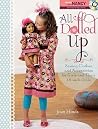
You're obviously meant to use this book to sew matching outfits for kids and their 18-inch dolls (I hate the gender essentialism in these books, but it's too prevalent to get worked up about lest I simply always be worked up, sigh), but what I really wanted was a selection of classic pattern pieces that I could make my own. Some of the pieces here are a little dated and some are so specific that I didn't think they'd customize well, but otherwise, that's mostly what I got!
The pattern pieces are well laid-out on large-format pattern paper in the back of the book. I've read multiple reviews now of people complaining that patterns laid out in that way are impossible to copy and I'm always like... ??? You literally just have to trace them?
So many pattern pieces, traced onto tracing paper because that is literally not a big deal?
I think the step-by-step instructions are very well-written and thorough, with illustrations for many steps. I would have liked options laid out for more advanced finishing techniques for seams, especially, but since I was intentionally making my favorite patterns multiple times in different colors and fabrics, I think I figured out nice ways to finish most of the seams.
Check out that nicely finished shoulder seam. No raw edges for my dolls!
My favorite patterns in this book are the Monkey Pajamas (but not with the Monkey applique because that part is kind of corny)--
--the ruffled capris (I also lengthened this pattern so that I could make a full-length pair of ruffled pants)--
--and the T-shirts, which worked fine as-is but which I also ended up modifying to make them a little roomier and to utilize the finished hems of upcycled thrifted shirts:
These T-shirts are exactly what I was thinking of when I was wanting a classic, easily modified pattern that I could customize however I wanted. They're simple, they work with all knit fabrics from jersey knit to ribbed knit to four-way stretch to stretch velvet, and I've currently got Mr. Craft Knife working on making me .svg files of cute little appliques that I can add to them.
Because if you thought that a doll-sized set of flannel dino jammies was cute, think about how cute a little dino T-shirt will be!
P.S. Want to follow along with my craft projects, books I'm reading, dog-walking mishaps, encounters with Chainsaw Helicopters, and other various adventures on the daily? Find me on my Craft Knife Facebook page!
Okay, I said that the American Girl doll T-shirts were my favorite thing to sew--and they are!--but these leggings are just almost my favorite thing to sew.
They're MUCH simpler than the T-shirts, for one thing. And they're just as cute, and just as amenable to every kind of knit fabric, from performance stretch to old T-shirts, so the possibilities are endless.
I actually didn't like this pattern, the Snow Day Pants from Doll Fashion Studio, by Joan Hinds, when I first made it, and the first pair of leggings that I sewed following the instructions as-written are now the American Girl doll equivalent of painting clothes, ahem. Like, the instructions tell you to zig-zag stitch the elastic straight to the raw edge of the waist? WHY, THOUGH, when there are so many options just as easy and way cuter?
I modified the pattern quite a lot, including lengthening it so I could also make a full-length version, and remembering that I have a random but huge stash of fold-over elastic in the closet that looks a LOT nicer sewn to raw edges, and now, I LOVE this pattern!
I love the fold-over-elastic at the waist and the ankles for the knit and rib knit fabrics:
And since I'd already made about a million American Girl doll T-shirts by the time I took a break for leggings, I also love using an old T-shirt for leggings, including its existing hem:
Even cuter when I realized that I had room on most old shirts to make both a doll T-shirt AND doll leggings! They're so perfectly matchy!
If you put them both on the doll, they're basically those jersey knit pajama sets that I used to put on my daughters, and that I would in all honestly 1000% wear myself if they just made them in my size.
I'm already working on an American Girl doll skeleton costume using a black T-shirt and leggings set. Stay tuned!
Alternatively, you can mix and match for comfy play clothes in any color range:
Anyway, I made a bunch of these leggings for my niece's doll, too, just because I think it's nice to have plenty of neutral-ish options for dressing her doll. The simpler the components, the bigger the scope for imagination!
As an example, lol, see the outfits that my kids came up with when I asked them to dress our dolls in some of these new clothes before I sent them off to my niece:
long-sleeved T-shirt, short-sleeved T-shirt, and 3/4-length leggings
full-length leggings made from four-way stretch, and a doll tunic a kid made once upon a time from one of their old newborn onesies
sleeveless dress, short AND long-sleeved T-shirts, and 3/4-length leggings
You can see I got a little lost in the weeds sewing doll T-shirts and leggings all summer, right? I kept thinking of new fabrics to test and pattern variations to try, and while I was doing that the summer whisked itself away and now I have to sew a bunch of witch hats as fast as I can.
OMG, y'all. SHOULD I SEW AMERICAN GIRL DOLL WITCH HATS?!?
P.S. Want to follow along with my craft projects, books I'm reading, dog-walking mishaps, encounters with Chainsaw Helicopters, and other various adventures on the daily? Find me on my Craft Knife Facebook page!
When I first started sewing doll clothes, I thought that the process was super complicated–all those tiny seams on all those tiny bits of fabric!–but it turns out that I was just picking out super complicated patterns. Like, I don’t even sew clothes with that many complicated construction techniques and fussy embellishments for myself, much less for a toy!
Fortunately, after lots and lots of sewing lots and lots of picky patterns, I got a lot more comfortable with winging it, and I figured out how to apply the elements of flat construction used in doll clothing to my favorite simple methods of sewing quick clothing pieces.
And now I’ve got all kinds of fun pieces that a kid can mix and match for the doll and that I didn’t have to spend an entire evening cussing down the house to sew!
This doll skirt is particularly easy to sew, even more so with the flat construction method that doll clothing uses. Although my photos here show me making skirts for my niece’s 18-inch doll, you can use this method to sew a skirt for any doll.
Here’s how!
Materials
To make a doll skirt for any size doll, you will need the following:
fabric. Scraps and stash work great for this project–if you can fold the fabric over twice and still stitch through it, you can use it! For the skirts in these photos, I used one of my kid’s old bedsheets for one skirt, and some stash quilting cotton for the other skirt. See Step 1 for dimensions.
elastic. You can use most types of elastic for this, so definitely prioritize what you’ve got on hand, but I use 1/4″ elastic for pretty much every doll clothing project, so that’s what I’ve got here. If you use a different width, you’ll want to recalculate the width of fabric you cut and the width of the fold for the elastic channel.
measuring, cutting, and sewing supplies.
Step 1: Measure and cut the fabric and elastic.
First, measure and cut the elastic for the skirt’s waist. Measure around the doll’s natural waist, and cut elastic to that exact measurement. You’ll lose .5″ from the length of the elastic when you sew the skirt, and that will provide plenty of snugness for a good fit.
For the skirt, first measure from the doll’s natural waist to the spot where you want the bottom hem of the skirt to hit. If you need to add a stitched hem, add .5″ to this measurement, but there are lots of circumstances in which you wouldn’t need to! For instance, I really liked the selvedge of the fabric that I used to make the skirt in the photo below, so I used that for the skirt’s bottom edge and didn’t hem the bottom at all.
For the sharks skirt that I’m sewing in these photos, I similarly used the finished edge of the sheet as my bottom hem–again, no extra sewing needed! The polka dot quilting cotton skirt is the only one in these photos that needed the extra .5″ for the bottom hem.
Assuming you’re using 1/4″ elastic for the waistband, add another .5″ to the measurement to accommodate the waistband casing.
The width of the skirt should be at least twice the length of the elastic, but you can go even longer, especially if your fabric is thin or drapey.
And for all of these measurements, since I’m explicitly trying to use up my stash, I fudge my measurements as necessary if it helps me use up a bit more stash. Would a skirt that’s 1″ longer or 2″ puffier let me avoid tossing a bit of scrap into the garbage? If so, that skirt is going to be a bit longer or puffier!
For a standard American Girl doll, my elastic measurement is 10.5″. My skirt measurement is 5.5″ long with a pre-finished bottom hem, and 6″ if I need to hem the bottom myself, and at least 21″ wide, but I’ll go up to 24″ if it helps me not have to toss a scrap.
Step 2: Measure, fold, and stitch the bottom hem and waistband casing.
If you’re hemming the bottom yourself, fold it over 1/4″ to the inside, then fold it again to hide the raw edge. Stitch along the folded edge to hem.
For the waistband casing, assuming you’re using 1/4″ elastic, fold the top edge of the skirt over 1/2″ to the inside. We’re not minding the raw edge, but if you do, just add enough length to the original skirt measurement to accommodate a double fold here, too.
For the tidiest waistband casing, you’ll be stitching twice: stitch one line along the raw edge, then stitch another line along the fold.
I think this makes the top edge of the waistband look just a little crisper. It’s a tiny detail, but surprisingly noticeable!
Step 3: Insert the elastic and stitch.
Pin a safety pin to one end of the elastic, then thread it through the waistband casing.
At each end of the casing, stitch back and forth to secure the elastic. This is different from circle construction, in which you’d sew the two sides of the skirt together, then insert the elastic, etc. Flat construction like this is often reserved specifically for doll clothing, but I don’t know why, because it’s genius!
Your skirt should now have a finished bottom hem and an elasticized top hem.
Step 4: Stitch the two sides of the skirt together.
Using a 1/4″ hem, stitch the two short sides of the skirt together, right sides together.
Iron the raw edges of the hem to one side, then stitch along the raw edge to make it tidy and flat.
In the above photo, you can see that the line of stitching is barely noticeable, but it’s one more little detail that makes this simple skirt look really nice.
These skirts are so quick and easy to make that they’re honestly kind of addictive. I had to force myself to stop at two so that I could write this tutorial, but just between us, I’m probably about to pop back into my studio and make just a few more.
And then maybe some shirts to match. And maybe a little sweater. And if I’m making a sweater, I should probably make a hat to match!
P.S. Want to follow along with my craft projects, books I'm reading, road trips to weird old cemeteries, looming mid-life crisis, and other various adventures on the daily? Find me on my Craft Knife Facebook page!
I started with the basic T-shirt pattern from All Dolled Up, by Joan Hinds, which is an absolute classic, a super versatile pattern with both short- and long-sleeved versions. It's perfectly fitted to the waist of the modern American Girl doll, so much so that you need to be very precise about where you place the back fasteners--
--and you'd likely need to alter that part of the pattern if you were sewing for a wider doll.
-and for fussy cutting elements from existing T-shirts. This perfectly proportioned Hawaii graphic T-shirt--
--came from a shirt that once upon a time belonged to a small daughter!
I also liked transforming a once VERY well-loved horse print daughter's shirt--
--into one that looks just like it, but smaller:
A few of these shirts in, though, I figured out that if I altered the pattern a little bit, I could actually cut the pieces to utilize the existing hems of old T-shirts, AND I could also seam rip off and use their neck ribbing, which I think makes the shirts look very realistic, as well as being more eco-friendly:
I also realized that I only have to zigzag seams along the neck and waist, so the top-stitching looks much neater!
The vintage shirt that I cut this T-shirt from was very pilled, so I didn't give this piece to my niece. I love it, though--it reminds me of my 70s childhood!
The exact color match of the neck ribbing to the rest of the T-shirt is the main detail in making the doll T-shirt look realistic, and that's completely solved when you upcycle an old T-shirt:
It's interesting to me to contrast the first T-shirt I made, on the left, to one of the more recent ones:
I was also trying to upcycle an old jersey knit pillowcase, including its existing seam, for that shirt on the left, and that didn't do it any favors.
There really is real benefit it making 100 of the same thing--every 20th iteration, you figure out how to make it a little better or you get an idea of how to do it a little differently!
I cannot emphasize strongly enough how SATISFYING these little T-shirts are to make. From fussy cutting tiny pieces to precisely top-stitching tiny seams, I swear that I spent half my summer humming happily to myself, listening to the latest Mumford & Sons album over and over and over again, and sewing doll T-shirts.
We didn't do a big summer trip this year, so I had to do something to keep myself entertained, I guess!
P.S. Want to follow along with my craft projects, books I'm reading, dog-walking mishaps, encounters with Chainsaw Helicopters, and other various adventures on the daily? Find me on my Craft Knife Facebook page!




.jpg)

.jpg)

.jpg)
.jpg)
.jpg)
.jpg)


