.jpg)
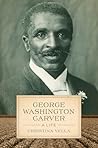 George Washington Carver: A Life by Christina Vella
My rating: 5 of 5 stars
ME, worriedly, every so often: "Please don't tell anyone how much I hate Booker T. Washington so they don't think I'm racist."
ALL FAMILY MEMBERS: "Okay, but you're the most likely person to tell someone that."
And fine, it's true, so here we go:
I hate Booker T. Washington. I think he did a really terrible job running the Tuskegee Institute (he did a really great job founding it--he just did a really terrible job running it!), I think a lot of what he said and did was wrongheaded, I think he should have been open to other leaders' ideas of how best to lift up their people instead of just stubbornly following his own personal brand of black-and-white thinking, I think he got distracted by showmanship too often.
But most of all, I hate him because he was really, really, REALLY mean to George Washington Carver for literally no reason. Washington acted like his whole purpose in life was to serve his people, and then turned around and stole away probably the greatest genius of that time and hid him away and made him work like a dog without any of the resources he could have so easily provided and then when Carver created miracles anyway, Washington acted like those miracles were garbage and just continued trying to stomp Carver down.
And for some reason beyond all comprehension, or really just because that's the kind of guy he was, George Washington Carver LOVED Booker T. Washington, loved him and admired him and had so much affection for him, and in return, Washington's every action toward Carver (after, of course, he'd gone to all the trouble to woo Carver into taking that job at Tuskegee) was filled with just palpable contempt. In George Washington Carver: A Life, author Christina Vella writes that every Christmas, Carver made these beautiful hand-painted Christmas cards for all his favorite people. They were masterpieces. Washington always got one, and barely even acknowledged them. But the next year, Carver would go right ahead and paint him another beautiful masterpiece, and Washington would again be all like, "Meh." But after Washington died (yay!) and another guy took over as head of Tuskegee, Carver went to all the trouble to make that guy his very own hand-painted Christmas card, too, because he was just that nice.
And that guy was so touched that he wrote Carver a genuine multi-paged THANK-YOU NOTE FOR THE CHRISTMAS CARD. THAT'S HOW MUCH HE LOVED IT.
Ugh, Booker T. Washington!
Honestly next I should probably read a proper biography of Booker T. Washington, because right now he exists solely in my mind as a cartoon villain.
He really was VERY mean to Carver, though.
Which I feel like is a pattern that started when Carver was a newborn! Susan and Moses Carver, the people who raised him from the time of his mother’s abduction (at least the official story is an abduction--I’d tell you what I think happened, but I feel like I have already expressed an unhealthy amount of George Washington Carver-centric conspiracy theories in my life and I think I'm already not getting invited to parties about it) to the age of nine or ten, allowed that nine- or ten-year-old to leave home and figure out his own means of sustenance and support when little George, with a knack for learning, decided that an education was what he really, really, really wanted for himself. Vella writes somewhat bemusedly that George didn’t seem to remember much of his childhood and/or would often simply tell some amusing anecdote that he’d contradict in a later interview. She attributes it to absent-mindedness, in that his focus was always elsewhere, but honestly I don’t buy it. As an adult, this dude seemed VERY focused on interpersonal relationships. He treasured his friends, and was kind to fans and acquaintances. I feel like if he couldn’t remember his childhood enough to even give a consistent count for the number of siblings he had, there was a reason for it. And if it wasn’t a memory issue but instead that he didn’t want to talk about his childhood and fiction was easier, well, there was a reason for that, too.
Thank goodness little unhoused Carver met people along the way who did help and nurture and support him, although he clearly witnessed and experienced a lot of trauma, too. And he made his own way. He cleaned houses, he took in laundry, and Vella tells a story in which as a child he talked his way into a job as a personal chef and to cover the fact that he didn’t know how to cook he got the lady of the house to demonstrate how to make every single dish so that he could, as he told her, “make it the way you like it.” And after that, he did!
After making his own way in the world, traveling to wherever there was a school he could learn in, pausing his enrollment periodically as he ran out of money, he finally got enough education to be accepted to Highland College in Kansas. He used the rest of his money to get himself there, but when he showed up, the head of the college was all like, “Oh. Yeah, we don’t actually admit Negros,” and Carver had to simply walk away, broke and with his dreams dashed AGAIN.
I hate you, too, Highland College.
Carver was, if anything, even more poor when he was finally able to attend Simpson College, an art school, and then after that, thanks to a teacher who took him under her wing, Iowa State College. But I feel like Iowa State was where he was the happiest in his entire life. He still cleaned and took in laundry, but Vella notes that his teachers and schoolmates and neighbors would make sure he at least had tons of work, because that’s the only way they could get him to take their money. In 1893, four of his paintings won entry into the Chicago World’s Fair, and Carver was going to get to go see them there. But all his clothes were garbage. So one day, some of his classmates literally kidnapped him off the street, manhandled him into a department store, forced him to try on clothes, and then bought him a beautiful new suit, completely against his will.
And you guys. I cry every time I tell this story, because it is literally so sweet and SO insane, because Carver basically NEVER TOOK THAT SUIT OFF AGAIN IN HIS ENTIRE LIFE. I mean, like, I’m sure he had pajamas, and he spent a lot of time in a lab coat, but if he was dressed up and out and about, he was wearing that suit. That twenty-year-old suit. That thirty-year-old suit. That FORTY-YEAR-OLD SUIT. It was always clean--Carver, after all, was a laundry man!--and it always had a fresh flower in its lapel, but people started to not be able to tell what color it was supposed to be. It was probably, like, dry rotting or something at some point. And sometimes, someone would be like, “Buddy, you want to get yourself a new suit or something?” And Carver, even after he finally had some money--although he never had money like he was supposed to, because Tuskegee never paid him a decent salary, much less the salary he deserved--would just be like, “But clearly I already have a suit I am literally wearing it right now?”
So here’s the thing: Vella makes very clear that Carver was super happy at Iowa State. Some people were for sure racist towards him but a lot of people were not, he had friends, he had mentors, he was learning and he loved it, he was blowing everyone away with how smart he was and how nice and how good he was at everything, and he already had an excellent job lined up right there as soon as he graduated, because these professors did NOT want to let him out of their sight, he was so awesome.
Enter Booker T. Washington.
And okay, to be fair to Washington, the people of Alabama, Black and white but especially Black, were just absolutely beyond destitute at this time. Anything that anyone could do to help them was a very good thing. But Washington had a very black and white, VERY limited idea of what was best for Black people as a whole, and he didn’t give a fuck that it wasn’t what many Black people wanted for themselves--he was going to do for them what HE wanted to do for them, and that’s it.
And what he wanted to do for them wasn’t so much to offer a proper school education, although to be fair Tuskegee did teach literacy and numeracy, but essentially to offer more sophisticated farming and industrial education. I think it was this weird wanting to serve his people but also hating intellectualism vibe that Vella describes that made him 1) work as hard as he did to woo Carver away from his perfect Iowa State prospects, but also 2) shit on everything Carver tried to do and act contemptuous of all his accomplishments and thwart all his efforts because Carver was clearly very intellectually gifted and treasured intellect, and that shone through as much as his kindness did.
So Washington refused to fund Carver’s teaching lab, causing Carver to resort to garbage picking and DIY to stock it. Carver scored a very prestigious federal grant to host an experiment station at the school, and Washington refused to assign him a consistent staff to work it. When Carver succeeded with the station anyway and published useful educational brochures, Washington refused to have them printed. It got so bad that when Washington learned that Carver had been teaching--for free! in his free time!--an extremely popular Bible study class for the past three years, he immediately shut it down. Tell me one reason why he’d do that that’s not from simple spite!
.jpg) |
| Tuskegee could have furnished his lab if they'd wanted to. |
But you know what? Carver took Washington’s contempt and Tuskegee’s garbage and with them, he performed wonders. He genuinely saved Alabama, and the South as a whole, with his research and outreach. Enslavers had used their access to free labor to monoculture cotton to such an extent that the land was completely devoid of nutrients, and so everyone who was still trying to live off the land had resorted to simply growing more and more of that same monoculture just to chase any kind of profit. People were malnourished because they’d converted their kitchen gardens to cotton. Same with their livestock yards. Part of Carver’s extensive research and outreach was finding nutritious, cheap crops and livestock that fed people, turned a profit, and also healed the land. Sweet potatoes. Hogs. PEANUTS!!! People were also longing for more elevated lifestyles but weren’t sure what that would consist of, so were spending their precious money on stupid stuff like fancy clocks and organs that represented culture to them (tangent, but I thought this detail was VERY interesting, because way north in De Smet, South Dakota, the Ingalls family was also spending their precious money on a stupid organ!). So Carver researched methods of making beautiful paints cheaply from the local soils, then taught everyone how to paint their homes and furnishings so they could have pretty things around them without wasting their money.
Another tangent: all throughout the book, Vella just keeps on referring to Carver’s “woman’s voice.” She genuinely goes out of her way to bring this up ALL THE TIME. Carver meets someone famous--they must be surprised to hear his woman’s voice! Carver gives a lecture--people probably thought it was strange hearing a woman’s voice! At one point, I swear she is absolutely giddy because Carver met a woman whom she says had an unusually deep voice, and she’s genuinely all, “OMG I BET IT SOUNDED SO WEIRD! BECAUSE HE SOUNDED LIKE A WOMAN AND SHE SOUNDED LIKE A MAN! AND WHEN THEY TALKED TO EACH OTHER IT WAS LIKE THE OTHER PERSON’S VOICE SHOULD BE COMING OUT OF EACH OF THEIR MOUTHS! HAHAHAHAHA!!!”
So anyway, I kept reading her taking these shots at Carver’s voice and being all, “Dude! Why is she obsessed with saying he sounds like a woman?” So I got on YouTube to see if there are any videos of Carver speaking.
There are. And fine, he sounds like a woman. Just… Vella acts weirdly excited about it, okay?
Anyway, *I* was very excited in the book when Booker T. Washington died, even though it caused Carver to go into genuine mourning for months and also donate half a year’s worth of his pitiful salary to a memorial for that asshole. I’m just so mad at how much of his life he gave up for that man.
There’s another whole weird part of the biography concerning how Carver apparently also gave up another huge chunk of his life to massaging people with peanut oil, because it got published in the newspapers as a miracle cure, causing people to show up from everywhere all the time asking him to, and he was too nice to say no. It’s super weird, though.
Another weird part: although everyone online seems to think that Carver was queer because he was life partners with the lab assistant he had late in his career, Austin W. Curtis, Jr., Vella does not think that this was true at all. Honestly, she low-key makes Curtis out to be a villain who made secret deals behind Carver’s back to profit off of their professional partnership and their friendship. Instead, she puts forth the VERY convincing case that Carver was queer because he was deeply in love with a much younger man whom he met through church stuff. He wrote him obsessive letters for years, letters in which you can literally feel the agonized longing, translated into Jesus-speak. This besottedness went mostly unreciprocated, poor dude. Honestly, I think Carver was probably aroace. His letters of religious fervor to that dude did sound pretty sexy, but I dunno, religion can be weird like that.
Eventually, Henry Ford befriended Carver and built him the fanciest of fancy labs. But you guys, you might as well go ahead and start crying with me again, because by then, Carver was too frail to get much use out of it. He just always worked so hard, and I feel like he never got exactly what he deserved out of life. I guess he’d be proud of his beautiful George Washington Carver Museum at Tuskegee, although I’m low-key mad about it, but his other memorial is literally at his enslavers’ house sooo…
So… I dunno, you guys. All I know about George Washington Carver I learned from his national park site and this biography and some really sketchy online content that I do not believe. People are such weirdos. So, did Vella do me dirty? Is Booker T. Washington actually awesome and now I hate him for no reason? Was Curtis really Carver’s lover and Vella simply won’t say?
Is it super weird that she kept saying he had a woman’s voice? I mean sure, it’s high-pitched--okay, it’s remarkably high-pitched--but she’s being weird about it, right?
P.S. View all my reviews
P.P.S. Want to follow along with my craft projects, books I'm reading, road trips to weird old cemeteries, looming mid-life crisis, and other various adventures on the daily? Find me on my Craft Knife Facebook page!
No comments:
Post a Comment